MobiDoc: Visualizing Accessibility of Medical Care (2024–2025)
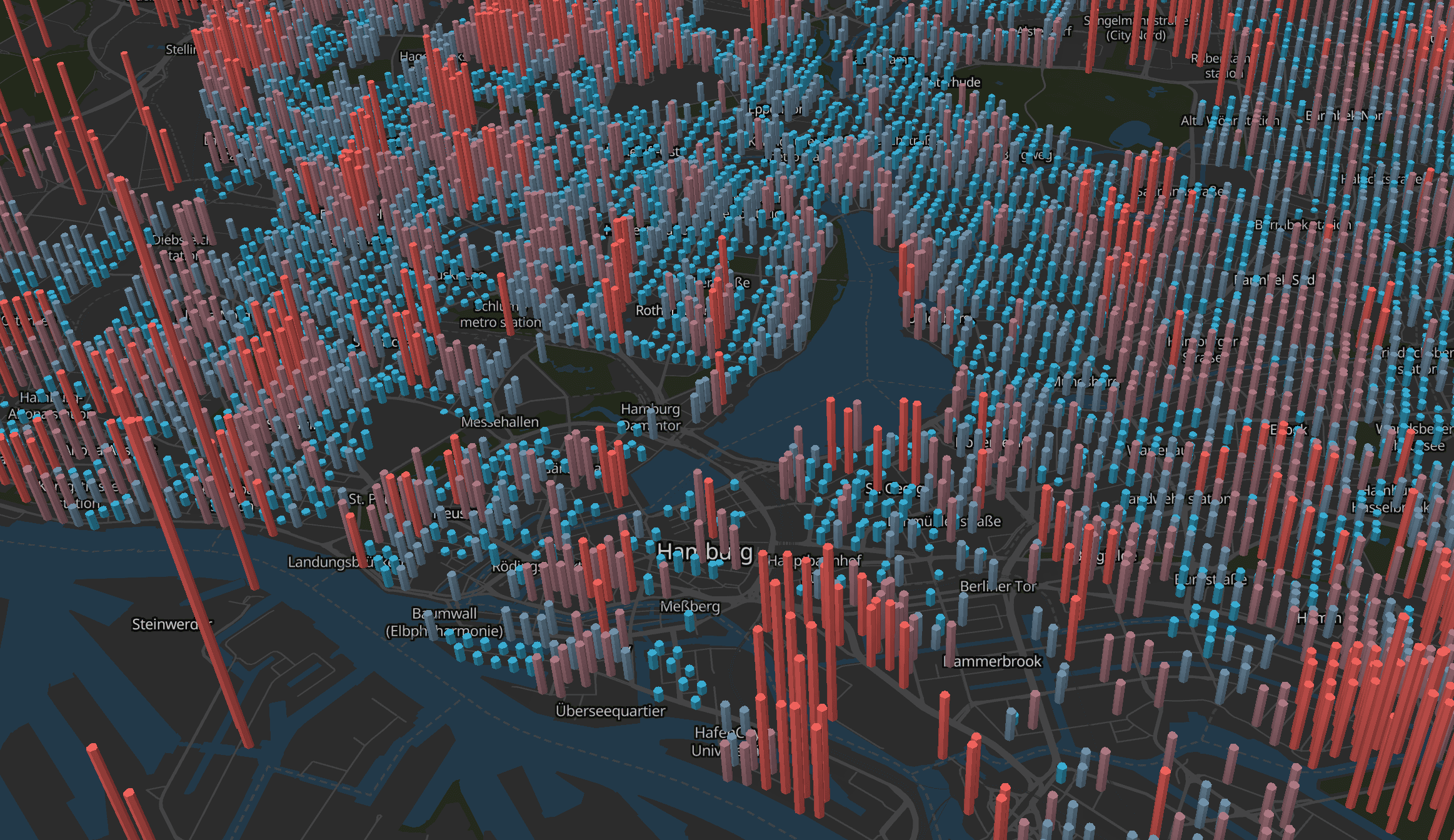
MobiDoc was a joint project with HafenCity University and the University Medical Center Hamburg-Eppendorf (UKE) on integrating uncertainty into accessibility analyses of medical care.
MobiDoc developed an extended framework for modelling and simulating accessibility to medical facilities in Germany in order to support more realistic and reliable healthcare planning. The project addressed shortcomings of conventional accessibility analyses by incorporating heterogeneous patient profiles, multimodal transport options including both car and public transport, dynamic information on physician locations, and explicit treatment of uncertainty in data and computation. Two contrasting case-study regions were used throughout the project: the city of Hamburg and the rural district of Lüchow-Dannenberg. Methodologically, the project implemented a Python-based analysis pipeline using census grid data as demand origins, OpenStreetMap road networks for car-based routing, and GTFS timetable data for public transport routing. Public-transport travel times were modelled across a representative morning time window, while uncertainty was integrated through assumptions about delays, cancellations, transfer times, and routing variability. At viu:lab, we developed a map-based visualization that communicates accessibility in travel time and its related uncertainty. By combining 2D and 2.5D views, we explored different ways of representing uncertain accessibility. A think-aloud study with expert users indicated that the 2.5D view was more effective for communicating accessibility uncertainty, despite its known limitations.
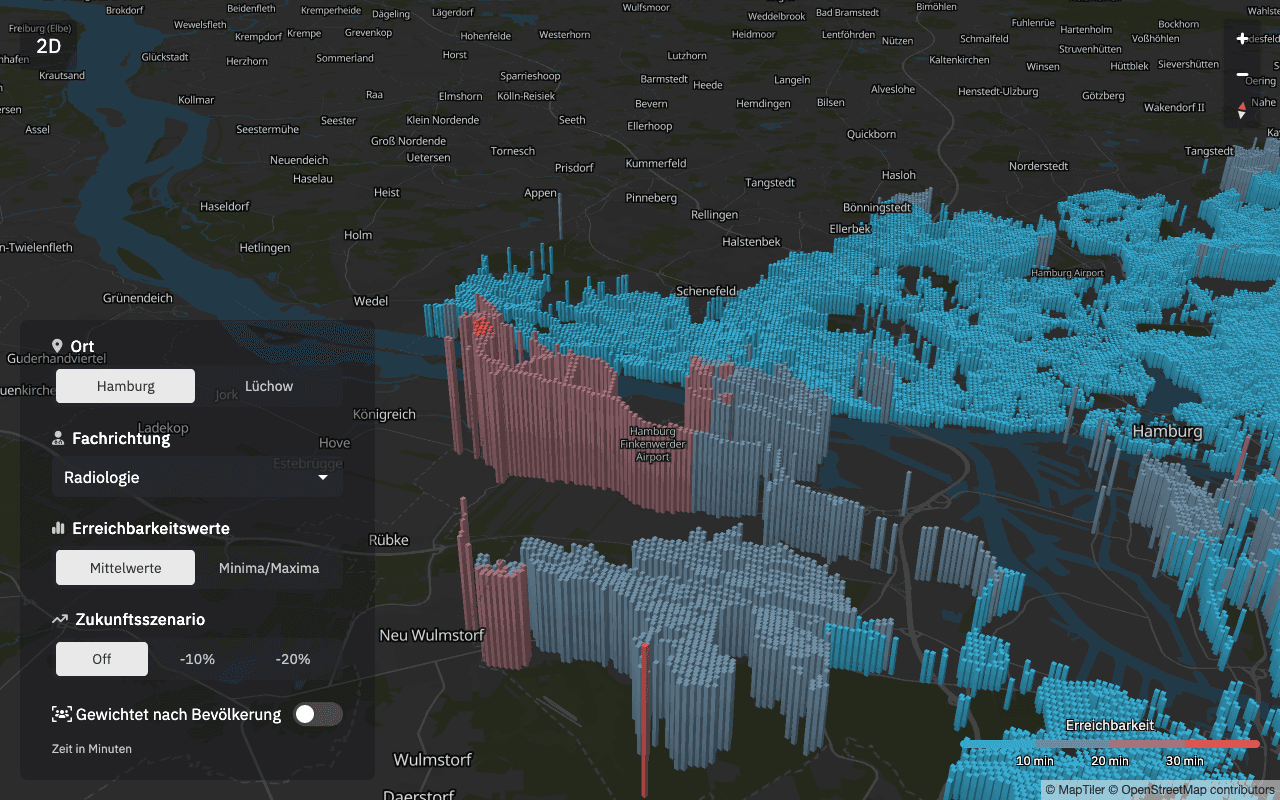
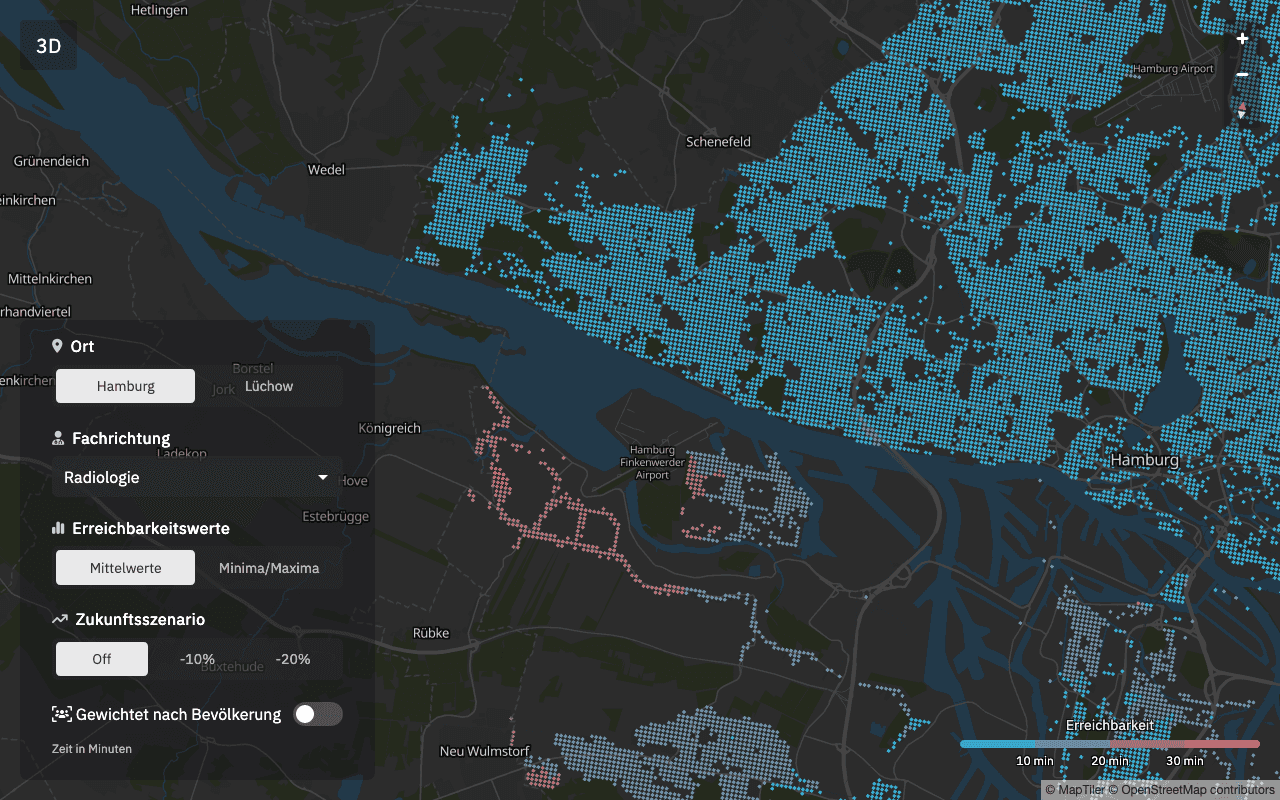
Check out the web demonstrator that displays accessibility and related uncertainty for different types of doctors in Hamburg and Lüchow.
This work was funded by the German Federal Ministry for Digital and Transport (BMDV) as part of the mFUND program (grant 19F1180C).